
SEO for Builders: How to Win the Job Before the Quote
18,100 UK searches a month for builders near me, and 32,000 more researching the project itself. How building and construction firms rank for both.

A plumber’s customer has water coming through the ceiling and rings the first number they see. A builder’s customer has a kitchen that is too small, and they will spend three months reading about extensions before they ring anyone.
That gap is the opportunity. “Builders near me” gets 18,100 UK searches a month (Google Ads data, August 2026). Searches for the project itself, the loft, the extension, the garage conversion and what each of them costs, add up to about 32,000.
This guide covers SEO for builders the way I’d approach it for a client: what people actually search, which searches your Google Business Profile wins, which need a page on your site, and what the work is worth against what the directories charge for the same enquiry.
What is SEO for builders?
SEO for builders means setting up your Google Business Profile and website so your firm appears when someone nearby searches for building work. It covers the map results, your pages in the normal listings, and whether AI tools name you when a homeowner asks who is good for an extension in their town.
The AI answers run on the same inputs. When someone asks Google or ChatGPT to recommend a local builder, the reply is assembled from your profile, your reviews and what your website says you have built.
The research happens before the phone call
Here is the split that should change how you spend your time.
| Type of search | UK searches a month | Who wins it |
|---|---|---|
| Finding a builder (near me, local, find a builder) | 23,800 | Google Business Profile |
| Researching the project (loft, extension, garage conversion, renovation) | 23,400 | Website service pages |
| Researching the cost of the project | 8,700 | Website pricing content |
Those are August 2026 figures. The first row is “builders near me” (18,100), “local builders” (1,900), “loft conversion near me” (1,900), “find a builder” (1,300) and “extension builders near me” (590).
The second is the six project terms in the keyword table further down, from “loft conversion” to “single storey extension”. The third is every cost search I could find, including “double storey extension cost” (480).
Together, the second and third rows are a third bigger than the first, and almost no builder’s website goes after them. Most have a homepage, a gallery and a “Services” page with eight bullet points on it.
Think about what that homeowner is doing. They are weeks or months from asking for quotes, and they are working out whether a dormer needs planning permission and whether £50,000 is a fair number. Whoever answers those questions has been in their head for a month by the time the shortlist is drawn up.
On a job this size, the shortlist is where the work is won. Nobody invites eight builders to quote for an extension.
The maths against paid leads
Job values first, because they set everything else. Checkatrade’s own cost guides put an average 20 square metre extension at £48,000 (guide updated June 2026) and a typical loft conversion at around £50,000 (updated March 2026).
The lead platforms price accordingly. MyBuilder charges when a homeowner shortlists you, and the fee scales with the value of the job. One member filmed shortlist fees of £540 and £940 on two large projects, payable whether or not he won either.
I track every published directory price in the UK trade lead cost tracker, updated quarterly, and the MyBuilder cost guide has the full breakdown. Subscription directories work differently: my reviews of Checkatrade and TrustATrader cover what a year of each really costs.
Google Ads tells the same story from the other side. Advertisers bid up to £20.25 a click on “extension builders near me” and up to £14.45 on “loft conversion near me” (Google Ads data, August 2026). That is one click, with no guarantee the person even fills in a form.
The map pack sits above those ads and costs nothing per click. An enquiry from your own site also arrives without a copy going to three other firms.
The keywords people actually type
From Google Ads data pulled in August 2026, UK volumes:
| Search | UK searches a month | What it tells you |
|---|---|---|
| builders near me | 18,100 | Won by your Google Business Profile, not your website |
| loft conversion | 9,900 | The biggest single project term. 18,100 in January |
| garage conversion | 5,400 | Underrated. Cheaper job, faster decision, 8,100 in January |
| house extension | 3,600 | Advertiser competition index of 100 out of 100 |
| loft conversion cost | 3,600 | Price research. Nearly doubles to 6,600 in January |
| kitchen extension | 1,900 | The customer’s words for a rear extension |
| garage conversion cost | 1,900 | Same intent as the row above it, one step closer to a quote |
| local builders | 1,900 | Map pack again |
| loft conversion near me | 1,900 | Ready to talk. Advertisers bid up to £14.45 a click |
| house renovation | 1,600 | Whole-house jobs, often a new purchase |
| house extension cost | 1,300 | Wants a number, and leaves if there isn’t one |
| how much does an extension cost | 1,300 | The same question typed as a sentence. 2,400 in January |
| find a builder | 1,300 | Average click price of £8.24 |
| single storey extension | 1,000 | Customers search by storeys, so structure your pages that way |
| extension builders near me | 590 | Small, and the dearest click in the trade at up to £20.25 |
| builders quotes | 480 | Average click price of £10.14 |
| groundworks contractors | 260 | Commercial and developer work |
Two things worth pulling out.
Customers name the room, not the structure. “Kitchen extension” gets 1,900 searches while most builders’ sites talk about “rear extensions” and “single storey builds”. Use their words in the heading and yours in the body.
And about one search in six is about money. If your site never mentions a price, you are absent from all of them.
The builder’s calendar, in search data
Every trade I have written one of these guides for has a season. Roofers have autumn storms, plumbers have the October boiler surge, and electricians barely have one at all.
Builders have January. “Builders near me” ran 27,100 in January 2026 against 12,100 the month before. “Loft conversion” goes from 9,900 to 18,100, “garage conversion” from 5,400 to 8,100, and “loft conversion cost” from 3,600 to 6,600.
The reason is not hard to guess. People spend two weeks at Christmas in a house that is too small for the family in it, and they start planning on the first Monday back.
Pages take three to six months to rank. A loft conversion page published in January is ranking by June, after the peak has passed. One published in September or October is in place when the searches double.
The work itself follows a few months behind, which suits the trade. January research becomes spring quotes and summer starts.
Your Google Business Profile does the heavy lifting
The map pack, the three businesses shown under the map, takes the calls for every near-me search in that table.
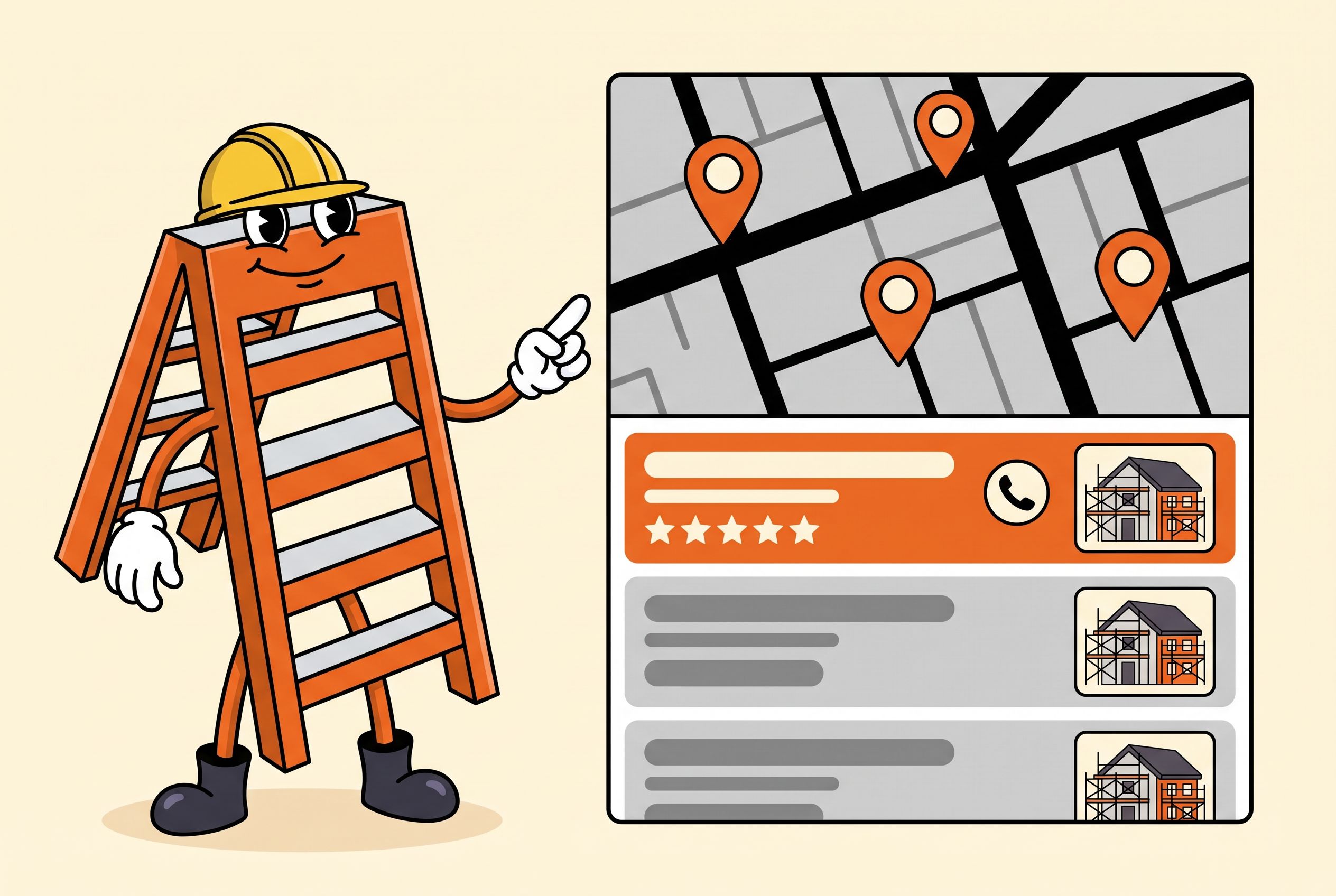
Most builders’ profiles are half filled in, so the bar in your town is low. A finished one has:
- A primary category that matches the work you want most. Look at what the three firms in your local map pack have chosen before you pick, then add secondary categories for the other work you take on.
- Service areas that match where you will actually drive to for six months. A loft conversion forty miles away means forty miles twice a day until it is finished.
- Photos of your own sites, at every stage. Footings, steels going in, first fix, the finished room. Homeowners want to see how you work, and a tidy site is a selling point.
- Every service listed individually, in the customer’s words: kitchen extensions, loft conversions, garage conversions, renovations.
- A post every time you finish a job, with the town and the type of project in it. It takes five minutes and most of your competitors have never posted once.
If your profile is not verified or you have lost access to it, fix that before anything else. I wrote up the Google Business Profile verification problems that come up most often.
One page per project type, not one services page
This is where the research traffic is won or lost.

Google ranks pages, not businesses. A page that gives loft conversions one bullet point among eight services is not a loft conversion page, and it will lose to a competitor who wrote 900 words on the subject.
Build one page for each of these, in this order:
- Loft conversions. The biggest term in the trade. Cover the types by name (rooflight, dormer, hip to gable, mansard), what each suits and a price range for each. I went through a real example line by line in my loft conversion service page guide.
- House extensions, split by single and double storey, because that is how people search. Put “kitchen extension” in a heading of its own.
- Garage conversions. Less competition than lofts, and a customer who decides faster.
- Renovations and refurbishments, aimed at people who have just bought a house that needs everything done.
- Whatever else earns well for you: new builds, structural work, basements, groundworks.
Each page wants a straight answer to four questions. What does it cost, how long does it take, do I need planning permission, and what will living through it be like.
That is also what gets you quoted in AI answers. Those systems lift specifics and skip pages that say “every project is different, contact us for a quote”.
Put a price on the page
I know the objection. Every job is different and you cannot quote without seeing the house.
A range on a web page commits you to nothing. The homeowner wants to know whether a dormer loft conversion is nearer £30,000 or £70,000, and Checkatrade’s guide will tell them £50,000 if you will not. About 8,700 searches a month are some version of that question.
Give a range, say what pushes a job to the top of it, and show two finished projects with what they came to. One line in the shape of “single storey rear extension, 24 square metres, 14 weeks, £62,000 including the kitchen” is worth more than any paragraph of sales copy.
A published range also filters your enquiries. The homeowner hoping for a £15,000 extension reads the page and does not ring, which saves you an evening pricing a job you were never going to win.
Case studies do for builders what volume does for other trades
A plumber finishes 400 jobs a year and collects reviews by the dozen. You might finish eight. Each one has to work harder.
Write every completed project up as its own page. Give the town, the type of job, the brief, the problems you hit, the timeline, a budget range and ten good photographs. It takes an hour and it sits on your site earning for years.
Those pages rank for searches you would never target on purpose, such as “dormer loft conversion” plus the name of a small town. They also give you location content with something real in it, where most firms publish fifteen copies of the same page with the town name swapped. My location page guide covers how to do that properly.
Put your accreditations where people will see them: Federation of Master Builders, TrustMark, and your insurance-backed warranty if you offer one. On a five-figure job, the customer is looking for reasons to trust you with a deposit.
SEO for construction companies: what changes with commercial work
If you are chasing commercial or developer work, the method holds and the audience changes.
Nobody procures a contractor from a “near me” search on a phone. A developer, architect or facilities manager already has your name from a tender list or a recommendation, and they search it to check you out. Your site’s job is to survive that check.
That means sector pages (education, retail fit-out, industrial units, housing), named projects with contract values and durations, and your accreditations up front: CHAS, Constructionline, SafeContractor and whatever else your clients’ pre-qualification questionnaires ask for.
The search volumes are smaller, as “groundworks contractors” at 260 a month shows. One contract can be worth more than a year of domestic work, though, so a page that wins a single enquiry has paid for itself.
Reviews decide who gets shortlisted
Two builders sit side by side in the map pack. One has 23 reviews at 4.9, the other has 4 at 5.0. On a £50,000 decision, the first gets the call and the second gets a closer look at best.
Ask at handover, when the client is standing in a finished room and the snagging is done. Send a text with a direct link to your review form that evening.
Ask them to say what you built and where. “Dormer loft conversion in Ilkley, finished on time” does more for you than “great job, would recommend”, because the next homeowner searching for exactly that reads it.
With so few jobs a year, you cannot afford to skip one. Eight projects and eight reviews is a strong year, and eight projects with two reviews is how most builders’ profiles look.
Your website has to hold its end up
The profile brings people to the site. The site has to keep them through a research process that lasts months, which means they will come back several times.
Your phone number belongs in the header of every page as a tappable link. A short enquiry form belongs on every project page, asking for the postcode, the type of job and a rough budget, so you can sort serious enquiries before you drive anywhere.
Photographs carry more weight here than for any other trade, so they need to be your own and they need to load quickly on a phone. A gallery of forty uncompressed images will lose the visitor before the first one appears.
If yours is not doing that, my websites for builders page shows what I build instead.
Doing it yourself versus paying someone
Do the profile yourself. It is free, it takes an evening, and it moves the needle more than anything else on this list.
Do the case studies yourself too, or at least take the photographs and write down the facts, because nobody else knows what happened on that job. The project pages are the harder half: five or six proper pages is several thousand words that have to be right about planning rules and honest about money.
If you want a second opinion before you spend anything, I audit trade businesses’ local visibility for free: a grid showing where you rank across your area, who is above you, and the three changes worth making first. No obligation, and you keep it either way. See where you rank and I’ll run yours.
Frequently Asked Questions
How much does SEO cost for a builder in the UK?
The foundations cost time, not money: a finished Google Business Profile, a review from every completed project and consistent details across directories. Paying someone typically runs £300 to £1,500 a month in the UK, depending on your area and how many services you want pages for. Set that against job value. Checkatrade's own guide puts an average 20 square metre extension at £48,000.
How long does SEO take to work for builders?
Map pack movement usually shows in 2 to 3 months, because most builders' Google profiles are half finished. Service pages for extensions and loft conversions take 3 to 6 months in most towns and longer in the big cities. Building work peaks in January, so a page started in September has time to settle before the searches arrive.
What are the best keywords for builders?
The biggest are 'builders near me' (18,100 a month), 'loft conversion' (9,900), 'garage conversion' (5,400) and 'house extension' (3,600), all UK figures from Google Ads data, August 2026. The near-me searches are won by your Google Business Profile. The project and cost searches are won by dedicated pages on your site, which most builders do not have.
Is SEO for construction companies different from SEO for builders?
The method is the same and the audience changes. A domestic builder is found by homeowners searching 'builders near me' on a phone. A construction company chasing commercial work is checked by a developer, architect or facilities manager who already has your name. Those buyers want sector pages, named projects with values and accreditations such as CHAS or Constructionline.
Can I do SEO for my building firm myself?
The parts that move the map pack, yes. Finishing your Google Business Profile, adding photos of your own sites and asking every client for a review at handover are free and can be done from a phone. The harder half is writing a proper page for each type of project with real prices in it. Most builders would prefer to be on site.
Is MyBuilder or Checkatrade worth it for builders?
Builders have the job values to make directories pay, and the platforms know it. MyBuilder prices its shortlist fee against the value of the work, and one member filmed fees of £540 and £940 on two large projects, payable whether or not he won them. Checkatrade members report £80 to £500 a month on a 12-month contract. Work out your cost per won job first.
Do builders need a website if they get work by word of mouth?
Word of mouth still gets checked. A homeowner about to spend £50,000 searches your name before they ring, and what they find either backs up the recommendation or undermines it. A site with finished projects, prices and reviews also reaches the people who have no builder to be recommended, which is most of the 18,100 a month searching 'builders near me'.
Want a Website That Actually Gets You Leads?
Get a free five-minute teardown video showing where you rank, who's beating you, and the first thing I'd fix.
Show Me Where I Rank