
Best Electrician Websites in the UK: 7 Real Examples and What Makes Them Work
Seven real UK electrician websites judged on whether they get the phone to ring: number in the header, NICEIC on the page, a page per service, prices shown.
Most electrician websites are judged on how they look. That is the wrong test, and it is why so many good-looking sites send their owners no work.
I run Handsome Local, a gallery of real trade websites with a full-page screenshot and a short review of each. This guide takes the seven UK electrician sites from it and asks a harder question of each one: would this get the phone to ring? Every site is real, every one is trading, and I have named the firm that built it where I know.
If you want the full method behind why these things matter, my guide to SEO for electricians covers it. This page is the evidence.
How I judged them
Five things, and none of them is the colour scheme.
- Is the phone number in the header, and does it dial when tapped? Most of this traffic is on a phone. A number that is buried, or shown as an icon, is an enquiry lost.
- Is the accreditation on the page, or implied? NICEIC, NAPIT, Part P. The badge, and ideally the number. “Fully qualified” in a paragraph does not count.
- Does each service have its own page? EICR, EV chargers, rewires, consumer units. One Services page listing fifteen things ranks for none of them.
- Is there a review count next to the stars? “5 stars” means nothing. “4.9 from 711 reviews” is proof.
- Is there a price, a range or a worked example anywhere? The page that stays silent about money loses to the one that does not.
Every site below passes at least three. Two pass all five.
The seven UK electrician websites
1. Charge At Home, North Yorkshire
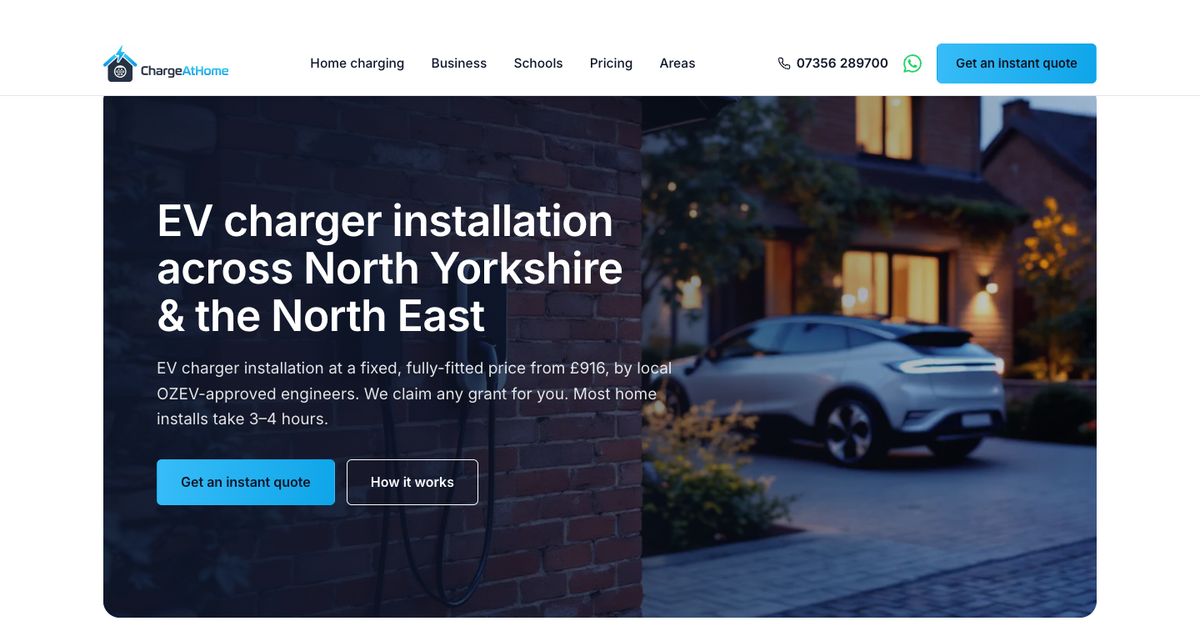
An EV charger installer near Northallerton covering North Yorkshire and the North East. I built this one, so weigh what follows accordingly, and then check the numbers.
The header carries the phone number, a WhatsApp icon and a Get an instant quote button. A strip under the hero names the OZEV approval, the DNO notifications and a five-year workmanship warranty beside the NICEIC Approved Contractor logo, so the trust signals are in the first screen rather than on an About page.
The part that does the work is the pricing. Six chargers are listed as fitted totals, from £916 for a basic 7kW unit to £1,142 for a solar-compatible Zappi, with the £350 grant explained in a box underneath. Every national installer network in this market makes you fill in a form to find out what it costs. This site tells you, which is why it gets the enquiry from the person who has already been to three of them.
Worth copying: the fitted price. If your job is one thing at a predictable cost, put the number on the page and let the nationals hide theirs.
2. Assured Electricians, Cardiff
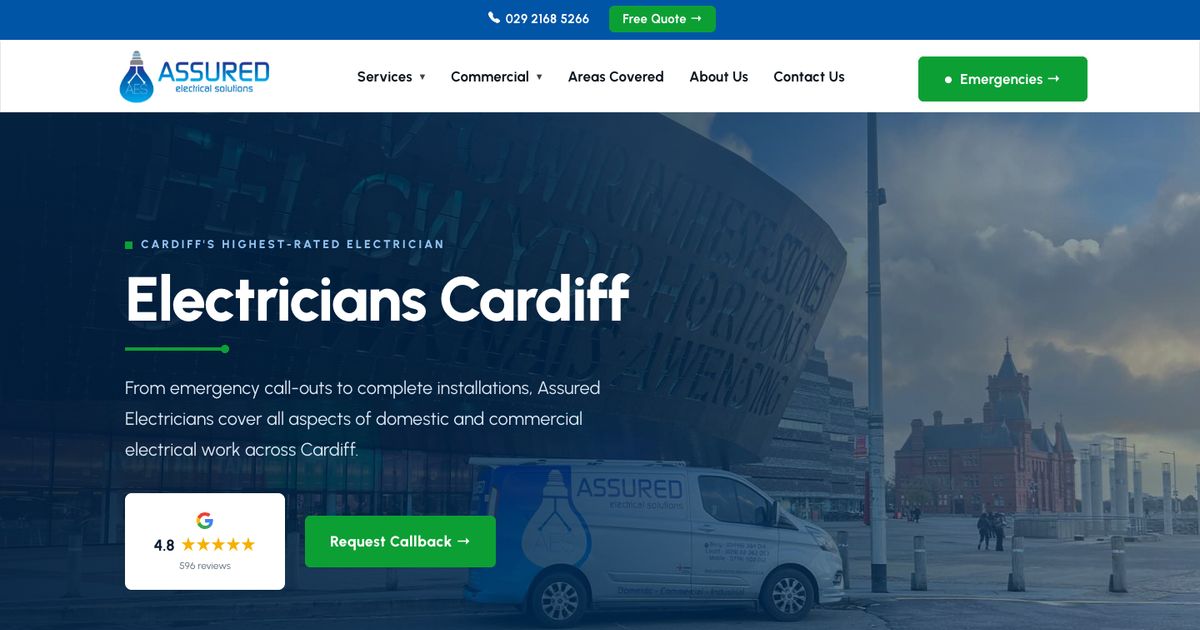
A NICEIC registered firm run by Jamie Parry since 2010, covering every CF postcode. This is the strongest all-round site of the seven and it passes all five tests.
The top bar has the phone number and a Free Quote button. A green Emergencies button sits in the header. The hero shows a Google card reading 4.8 from 596 reviews next to a Request Callback button, over a photo of the firm’s van parked at Cardiff Bay. Lower down, ten accreditation pills from NICEIC Registered to TrustMark sit above the logos, the team appears beside two liveried vans, and the company number is printed in the footer.
Nothing here is clever. It is every trust signal a nervous homeowner could want, placed where they will see it before they have scrolled.
Worth copying: the review count in the hero. Not the stars, the number. 596 does the persuading on its own.
3. MJP Electrical Services, Bristol
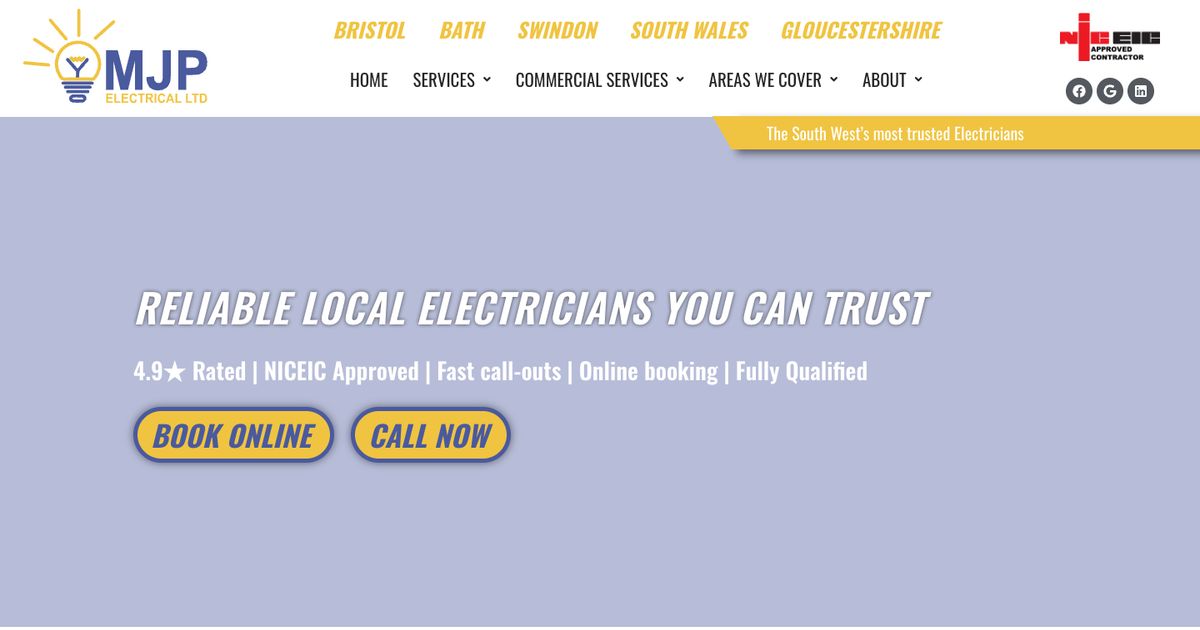
A family-run NICEIC approved contractor in Bristol that also covers Bath, Swindon, South Wales and Gloucestershire. The other site that passes all five.
Book Online and Call Now buttons sit under the headline. A strip beneath the hero pairs the NICEIC logo with a Google rating of 4.9 from 711 reviews. Six accreditation logos, from Part P to City & Guilds, sit under a photo of the owner, and the company number is in the footer.
What sets it apart is the FAQ, which prints the actual numbers: an urgent call-out is £171 plus VAT for the first hour, then £28.50 plus VAT per half hour. Almost no electrician does this. Almost every customer wants it before they ring.
Worth copying: the call-out rate in writing. It filters out the people who were never going to pay it and reassures the ones who were.
4. LA Electrical & Solar, Bristol
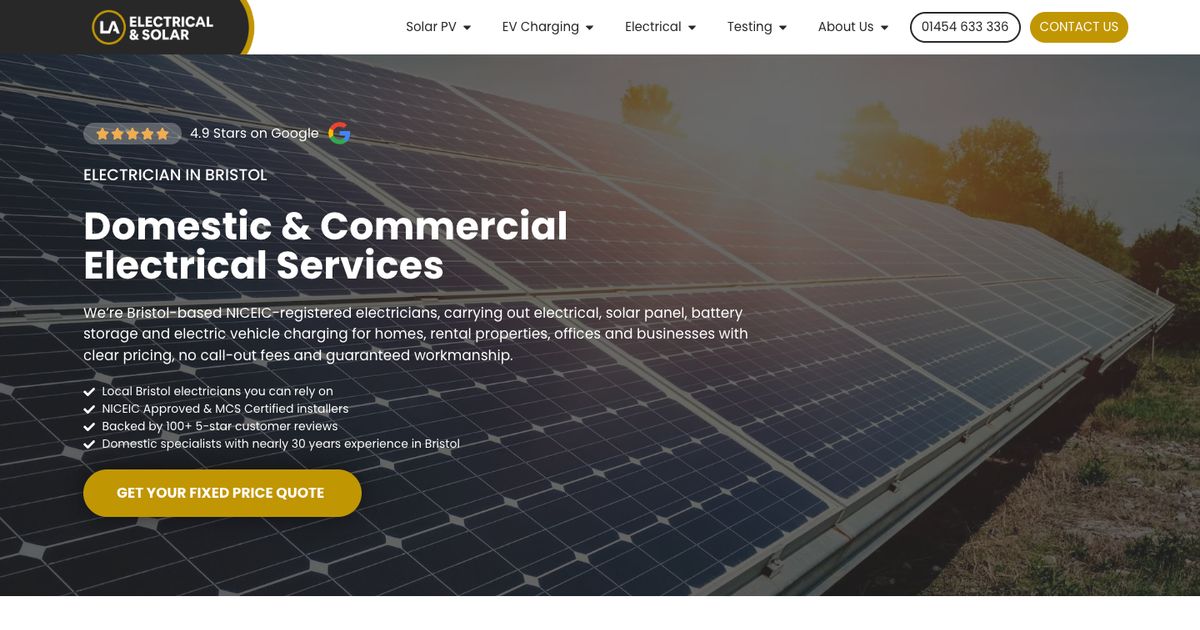
A two-person NICEIC approved, MCS certified electrical and solar firm covering Thornbury, Bradley Stoke and South Gloucestershire.
The header holds the phone number as an outlined button next to a yellow Contact Us. The hero states 4.9 stars on Google and 100+ five-star reviews above a Get Your Fixed Price Quote button. The about section pairs a selfie of the two electricians in their workshop with a signature, and the NICEIC Approved Contractor logo has a dark band to itself. Recent work is a written case study rather than a grid of photos.
It is a plain layout, and it does not need to be anything else. A two-person firm selling on accreditation and a fixed price, and the page says exactly that.
Worth copying: the fixed-price promise in the button text. “Get Your Fixed Price Quote” answers the customer’s biggest fear before they click.
5. AMP Electrical, Manchester
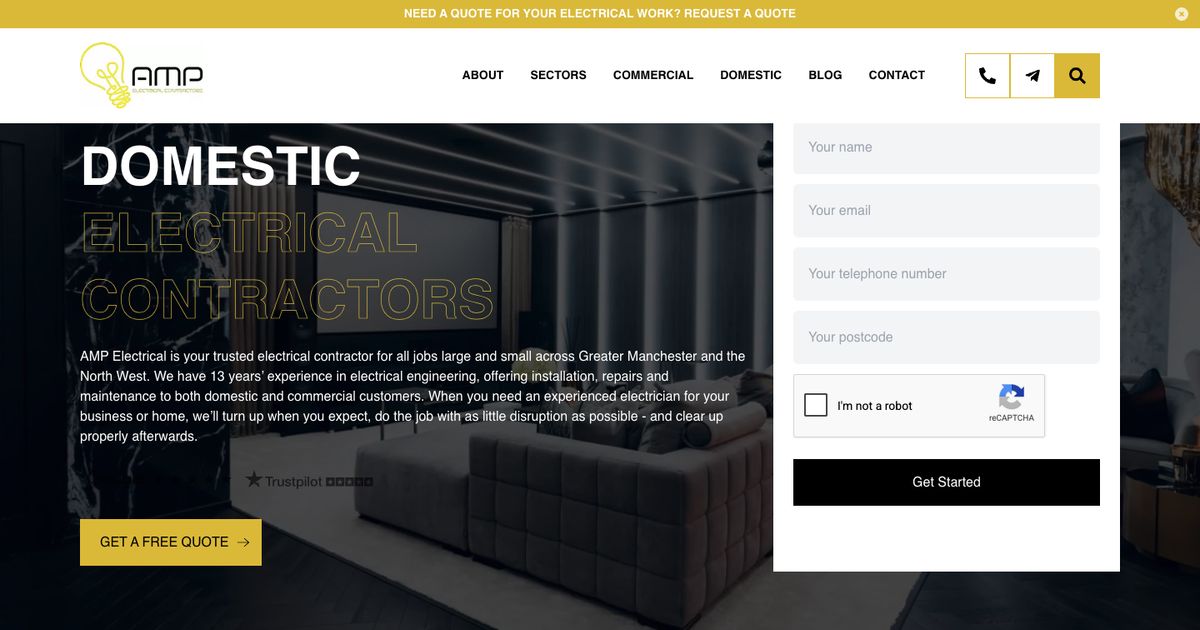
A family-run NICEIC contractor working across Greater Manchester and the North West, with commercial and domestic work given separate sections of the navigation.
The hero pairs the headline with a quote form asking for name, email, phone and postcode, and a Trustpilot rating sits under the copy. A photo of the firm’s liveried vans lined up outside its depot carries the customer care section. The footer stacks IPAF, PASMA, City & Guilds and CHAS logos next to Google and Trustpilot stars.
One thing to notice: the header shows a phone icon rather than the number. For a contractor with an office and someone answering the form, that is a deliberate choice to get the form filled in first. For a sole trader on the tools, it would be a mistake.
Worth copying: splitting commercial and domestic in the nav. The two customers want different things, and one page trying to serve both serves neither.
6. L&V Electrical, Worthing
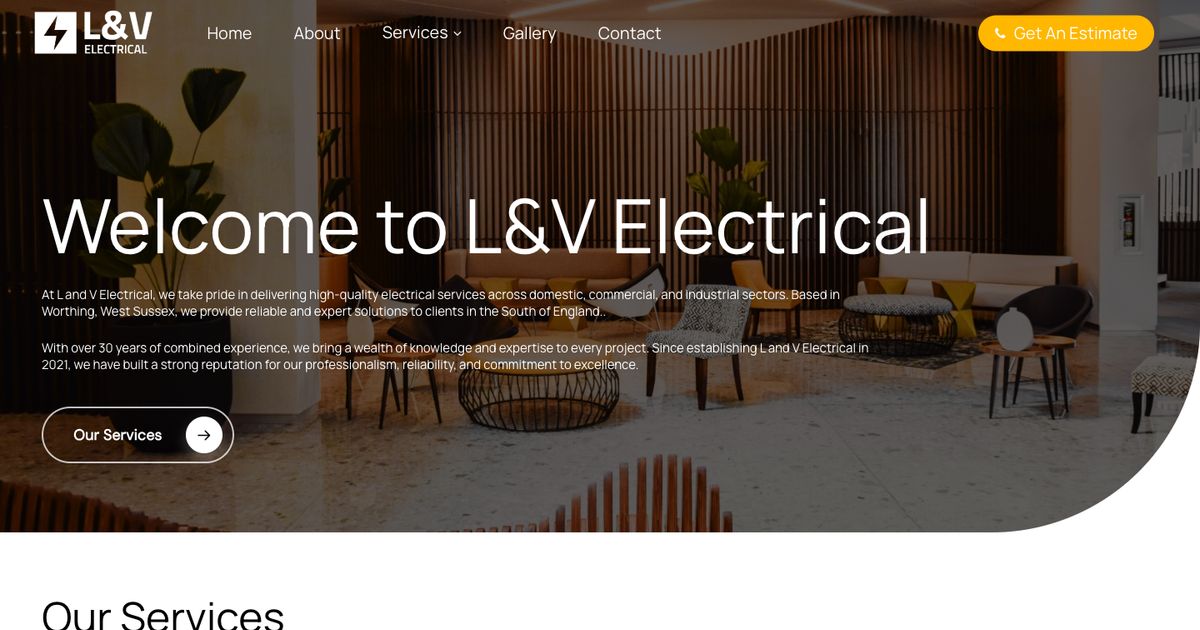
A NICEIC approved firm established in 2021, taking domestic, commercial and industrial work across West Sussex.
The header leaves the phone number out and puts a yellow Get An Estimate button in its place, so the footer does the trust work: City & Guilds, NICEIC and CHAS logos beside the Goring Road address, the company number, and a list of seven towns covered from Brighton to Littlehampton. Four testimonials name the customer and the job.
This is a young firm that wants to look established, and the site manages it by keeping the proof below the fold rather than pretending it is not there. The one thing I would change is the header. A phone number costs nothing and this is the second site in the list without one.
Worth copying: the towns in the footer. Seven named places is seven searches this site can rank for that a “serving West Sussex” line never would.
7. JPR Electrical Services, Bristol and Bath
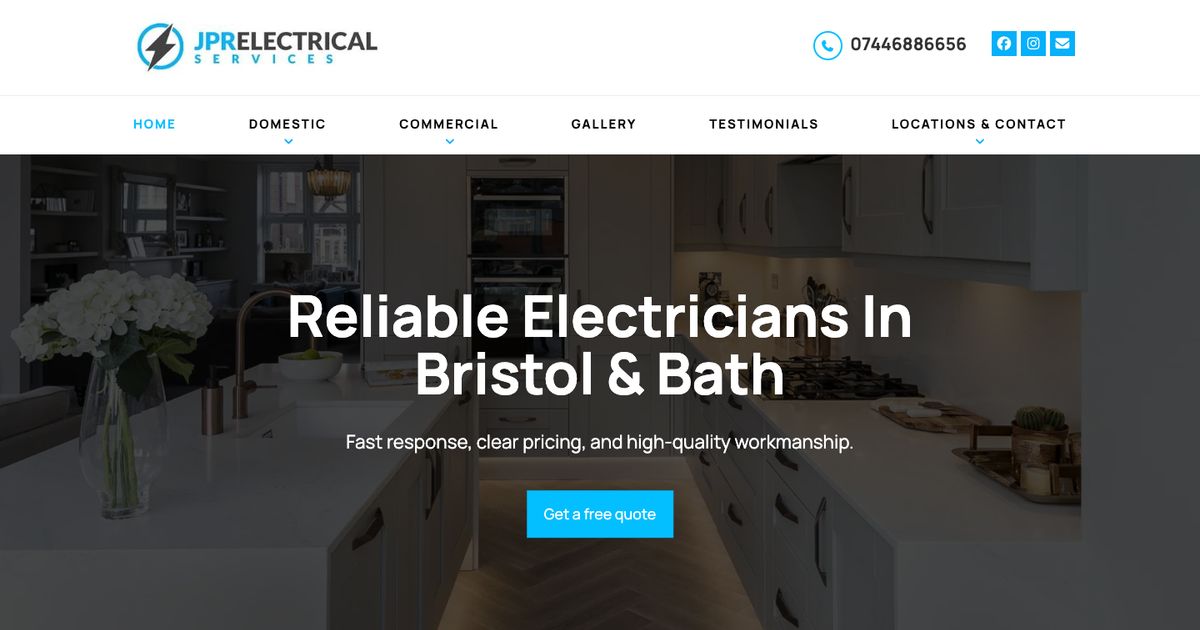
A one-man firm run by Jack, who is named in every testimonial. Built by Webfactory, and the most honest template for a sole trader in this list.
The phone number sits top right of the header on a white ground, and the hero carries a single Get a free quote button. Below a section aimed at builders and developers, four service tiles cover house rewires, EV chargers, consumer unit upgrades and EICR, each with a photo of Jack’s own work, including a Zappi on a fence and an opened consumer unit. Four reviews follow with the customer’s name and the job. Opening hours are printed in the footer, seven days a week.
No booking system, no review widget, no accreditation strip. It does not need them. It has the phone number, the four services that matter, and proof that a real person did the work in the photos.
Worth copying: the photos of your own jobs on the service tiles. The opened consumer unit does more than any stock image of a smiling man in a hard hat.
Two from the US worth a look
The American franchise sites are built by people with bigger budgets and more data than any UK sole trader will ever have, which makes them worth stealing from selectively.
Mister Sparky of Oklahoma City
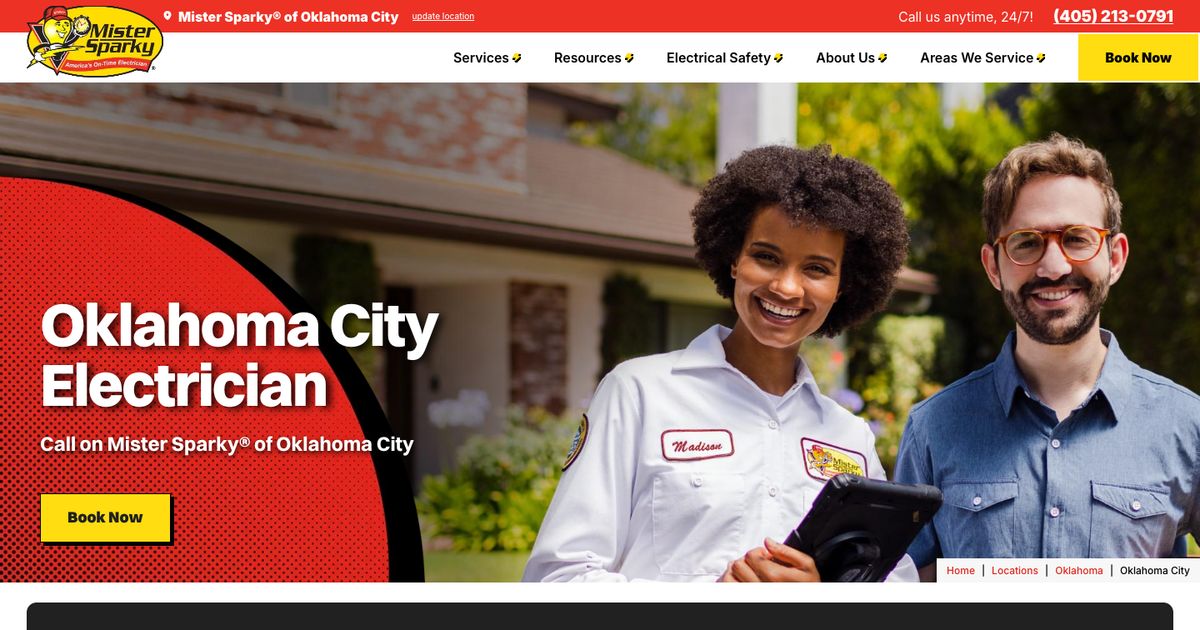
A branch page on the national Mister Sparky site. The red top bar reads “Call us anytime, 24/7” beside the phone number, and a yellow Book Now button ends the menu and then repeats in every band down the page. The footer prints the office address and licence number 042475.
The lesson is repetition. However far someone scrolls, the booking button is in view. Most UK sites put one call to action in the hero and hope.
Mr. Electric of Houston Midtown
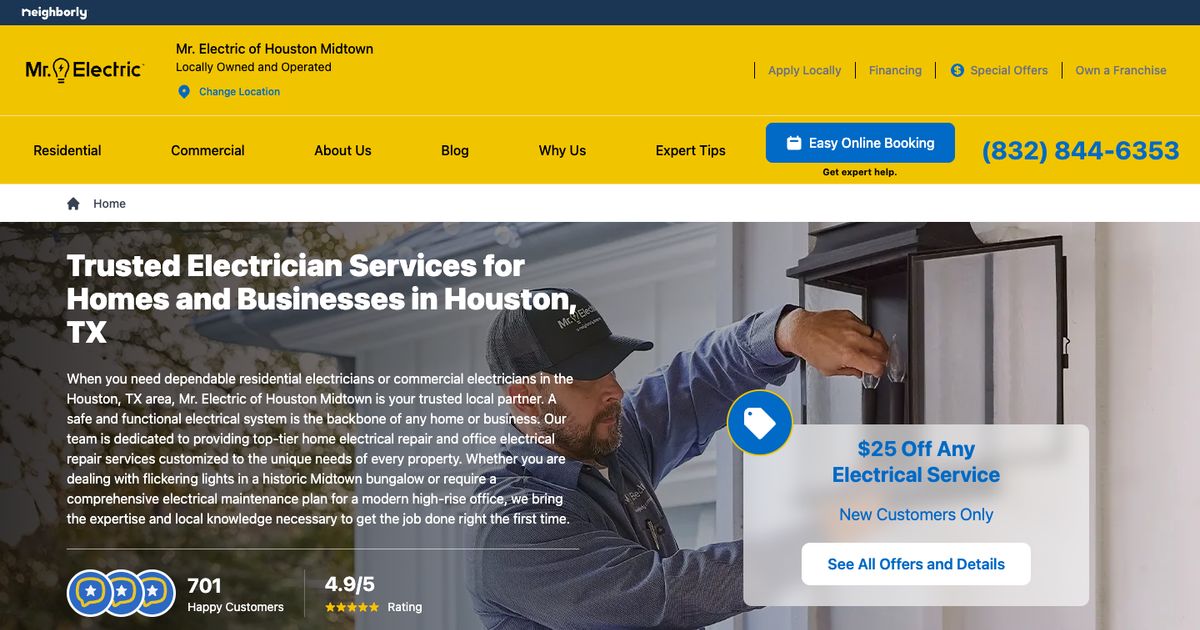
The yellow header carries an Easy Online Booking button and the phone number at headline size. The hero puts a booking form directly under the intro. Beside it, a counter reads 701 happy customers with a 4.9 rating, a Google map outlines the service area with a list of neighbourhoods, and the footer prints licence TECL 41720.
The lesson is the licence number. Not the badge, the actual number, in the footer of every page. Two of the UK sites above do the same with their company number, and it is the cheapest trust signal there is.
What the best ones have in common
Put the seven side by side and the pattern is obvious.
The phone number is in the header on five of them, and the two that leave it out are the two I would change first. The accreditation is visible in the first screen on six. Every one of them uses photos of its own vans, its own people or its own jobs somewhere on the homepage, and none of them leads with stock.
The review count appears next to the stars on four. The two that print a price are the two that pass every test. And the sole trader site with the least on it, JPR, is arguably the most effective for its size, because it has the four things that matter and nothing that gets in the way.
What none of them do
Not one of the seven has a page built to rank for “EICR [town]” on its own. Several list EICR as a service and one gives it a tile, but the term that gets 22,200 UK searches a month (Google Ads data, July 2026) does not have a dedicated page on any of these sites.
That is the gap. It is the same gap on almost every electrician website in the country, and it is where the compliance work that repeats every year is sitting unclaimed.
If yours does not compare well
The honest thing to do is run the five tests on your own site. Phone in the header, accreditation on the page, a page per service, a review count, a price. Count the passes.
If it is under three, the websites for electricians page shows what I build instead, at £199 a month with the build included and the site yours to keep. If you would rather see where you stand first, I audit trade businesses’ local visibility for free: a grid showing where you rank across your area, who is above you, and the three changes worth making first. No obligation, and you keep it either way. See where you rank and I’ll run yours.
Frequently Asked Questions
What should an electrician website include?
A phone number in the header that dials when tapped, your NICEIC, NAPIT or Part P registration shown rather than implied, a separate page for each service you want work from, a Google review count next to the stars, and at least a price range. Photos of your own jobs and your own van beat stock every time. The seven sites in this guide show each of those done well.
Do electricians need a website if they are on Checkatrade?
Yes, if you want the enquiries that are not shared with three other electricians. A directory listing sends you leads it also sells to your competitors, and the reviews on it are not yours to keep. Your own website ranks for searches like 'EICR [your town]' and sends you the enquiry alone. Most of the sites here run both, and the website is the one they own.
How much does an electrician website cost in the UK?
Anywhere from a £20-a-month template you build yourself to £3,000 or more from an agency. The sites in this guide range from a sole trader's straightforward template to multi-area contractors with booking systems. What separates them is not budget but whether the phone number, the accreditation and the service pages are actually there. I build electrician websites for £199 a month with the build included, and you own it outright.
Should an electrician put prices on their website?
The ones that do get fewer wasted calls and more of the right ones. MJP Electrical prints its urgent call-out rate on the page, Charge At Home lists every charger as a fitted total, and both are among the best-performing sites in this list. A price range or a worked example is enough. The page that says nothing about money loses to the one that does.
What is the best platform for an electrician website?
Six of the seven UK sites here are on WordPress and one is on Astro, and the platform is not what separates the good ones from the rest. What matters is whether it loads fast on a phone on mobile data, whether you own the domain and the hosting, and whether someone can update it without a developer. Pick on those, not on the brand of the software.
Want a Website That Actually Gets You Leads?
Get a free five-minute teardown video showing where you rank, who's beating you, and the first thing I'd fix.
Show Me Where I Rank