
SEO for Roofers: How to Rank Where the Work Is
33,100 UK homeowners search 'roofers near me' every month. Here is how a roofing company ranks for the ones nearby, with real search data throughout.
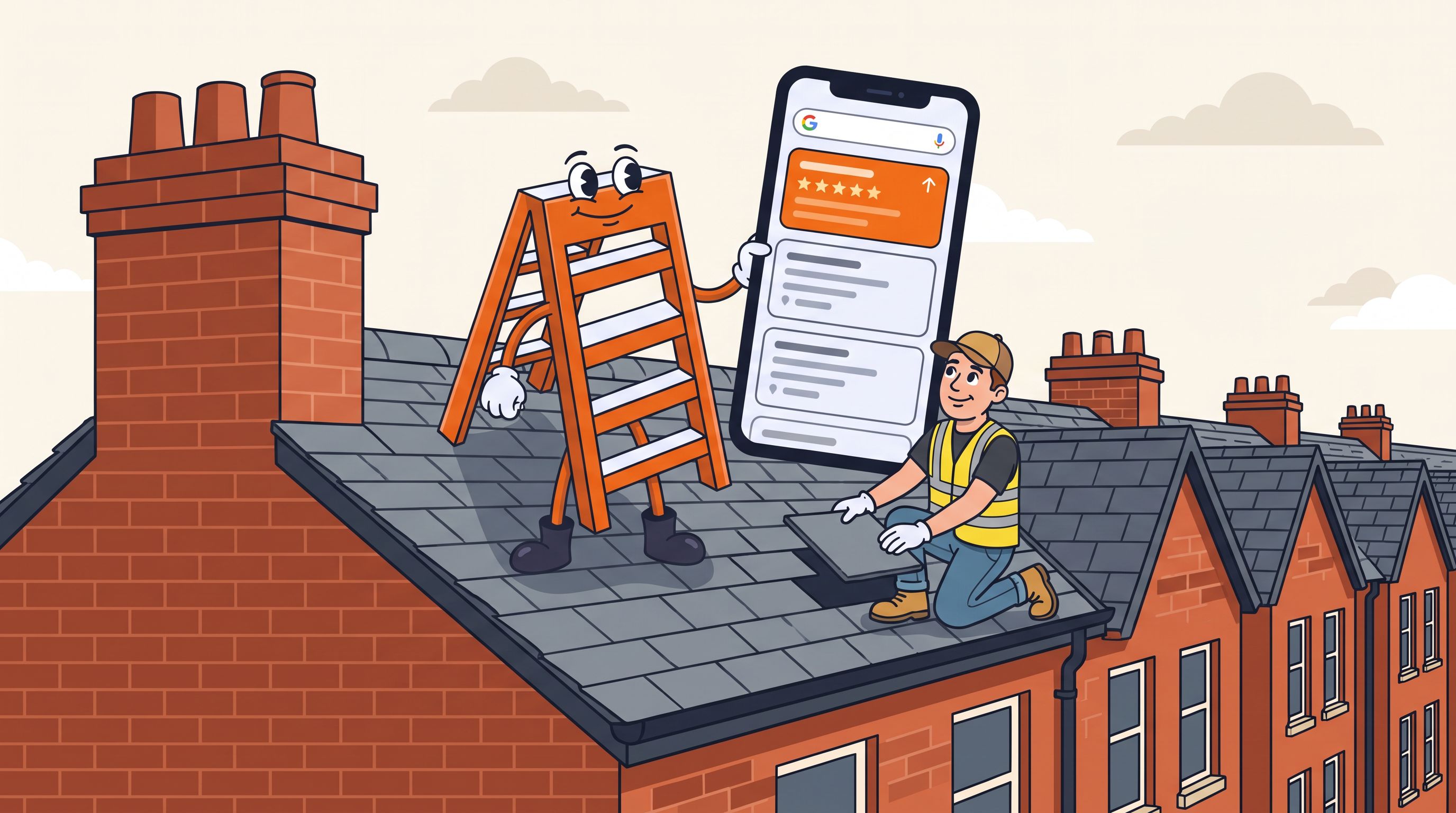
33,100 people in the UK searched “roofers near me” last month. Another 9,900 searched “roof repairs near me” (Google Ads data, August 2026).
That is the whole argument for SEO for roofers in two numbers. The work is already being searched for. The only question is whose phone rings.
I build websites for roofing companies and audit their search rankings every week, and the same pattern comes up constantly. The roofer doing the best work in town sits on page three, while a competitor with a tidier Google profile takes the calls.
This guide covers what actually moves rankings for a UK roofing business, with real search data, real costs, and honest timelines. No jargon, and nothing you need a marketing degree to follow.
What is SEO for roofers?
SEO for roofers means setting up your website and Google Business Profile so your company appears when local homeowners search for roofing services. It covers your position in the map results, your service pages ranking in normal search results, and increasingly whether AI tools recommend you by name.
That last part is newer. When someone asks Google or ChatGPT “who’s a good roofer near me”, the answer is assembled from the same sources: your profile, your reviews, and what your website says you do. Rank well in one and you tend to appear in the other.
The maths against paid leads
Most roofers I speak to already pay for leads from Checkatrade, MyBuilder or a lead reseller. Those platforms charge £15–£60 for a single roofing lead (UK Roofing Leads cost comparison, 2026), and the lead usually goes to more than one firm.
Tradespeople report converting roughly one job per 5–8 paid leads. At those rates a single won job carries £75–£480 in lead fees before you’ve bought a tile.
I track these numbers across every major UK platform in the trade lead cost tracker, updated quarterly.
Ranking on Google changes the economics. The click costs nothing, the enquiry is exclusive to you, and the customer already chose you before calling. That is why advertisers bid up to £26 per click on “emergency roof repair” (Google Ads data, August 2026). The search result you rank for is one someone else is renting.
A roofing website that converts turns those free clicks into booked jobs. The rest of this guide is about earning the clicks.
The keywords homeowners actually type
Forget guessing. Here is what UK homeowners search every month, from Google Ads data pulled in August 2026:
| Search | UK searches a month | What it tells you |
|---|---|---|
| roofers near me | 33,100 | Won by your Google Business Profile, not your website |
| roof repairs near me | 9,900 | Same. Urgent, high intent, map pack territory |
| flat roof repair | 4,400 | Needs its own service page |
| roof moss removal | 3,600 | Cheap jobs, but a foot in the door and easy to rank for |
| roof leak repair | 2,400 | Urgent. Pair with emergency messaging |
| new roof cost | 1,900 | Price research. A pricing guide page captures these early |
| gutter replacement | 1,600 | Add-on service worth its own page |
| chimney repair | 1,000 | Low competition in most towns |
| emergency roof repair | 880 | Advertisers pay up to £26 a click for this one |
| flat roof replacement | 720 | High job value, worth a dedicated page |
Two things stand out from the monthly patterns behind these numbers.
Demand peaks between January and March. “Roofers near me” hit 60,500 searches in March 2026, nearly double a quiet month, because winter storms create roofing emergencies. Rankings you build in autumn are in place for the surge.
And the “near me” searches dwarf everything else. Which is why the next section matters more than your website.
Your Google Business Profile does the heavy lifting
The map pack (the three businesses Google shows with a map) takes the calls for “roofers near me” and every search like it. For urgent work, plenty of customers never scroll past it.
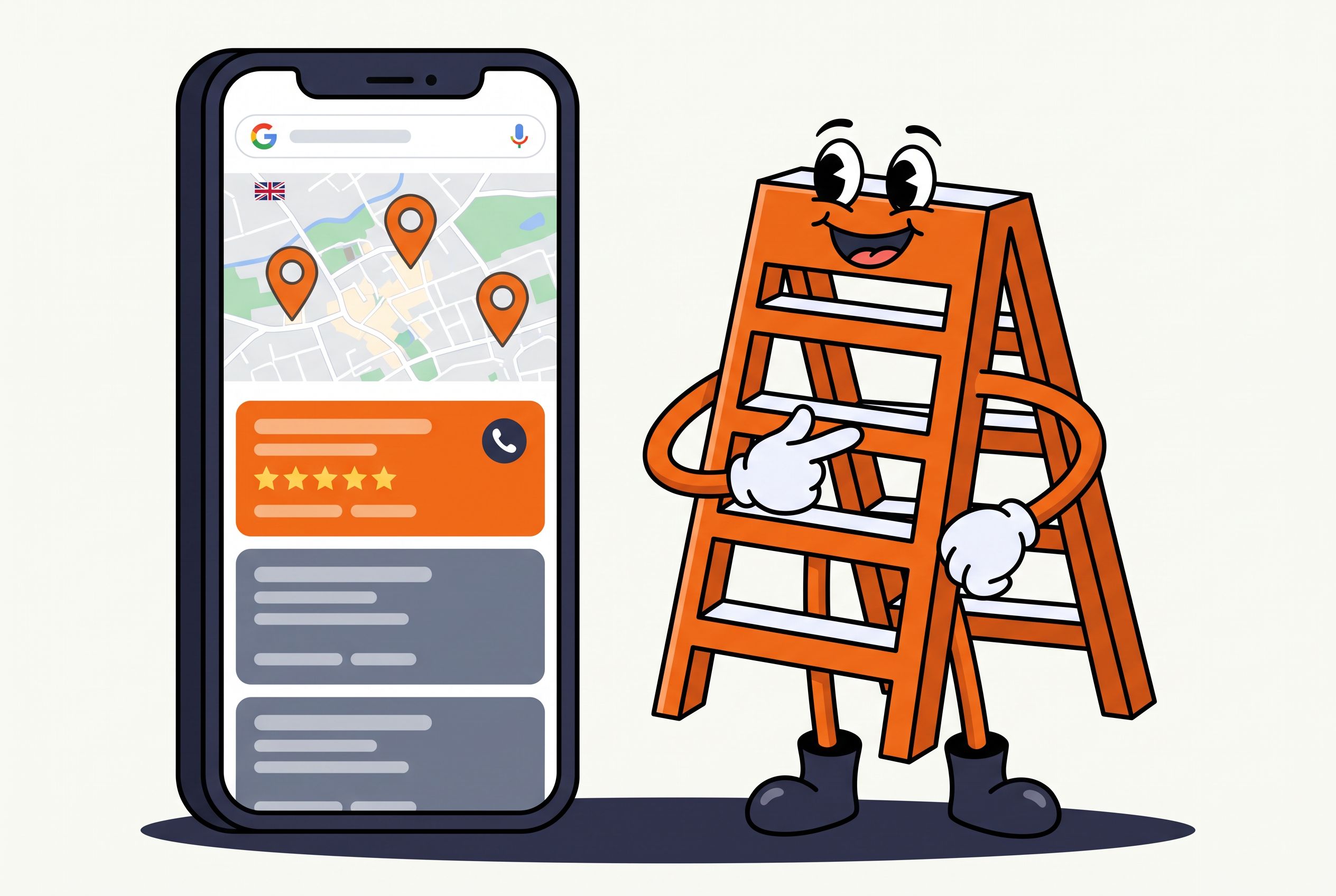
Most roofers’ profiles are half finished, which is good news. It means the bar in your town is low. Here is what a finished one looks like:
- Primary category set to “Roofing contractor”, with secondary categories for guttering, chimney or flat roofing if you do them.
- Every service listed individually in the services section, with a sentence of description each.
- Your real service area, set as the towns you cover rather than a single pin if you travel.
- Photos from actual jobs, uploaded steadily. A profile with fresh photos every month beats one with ten photos from 2022.
- Posts when you have something real: a completed re-roof, storm damage availability, a before-and-after.
If Google won’t verify your profile, or it got suspended after an edit, I’ve written up the fix in this Google Business Profile verification guide.
One warning from audits I’ve done. Keyword-stuffing your business name (“Smith Roofing | Best Roofer Leeds | Emergency Roof Repairs”) violates Google’s rules and gets profiles suspended. Your name is your name. Google’s own guidance on improving local ranking is short and worth ten minutes.
One page per service, not one services page
Google ranks pages, not businesses. A single “Our Services” page listing everything you do cannot rank for “flat roof repair” against a competitor with an entire page on it.
The service list from your quote book is your sitemap:
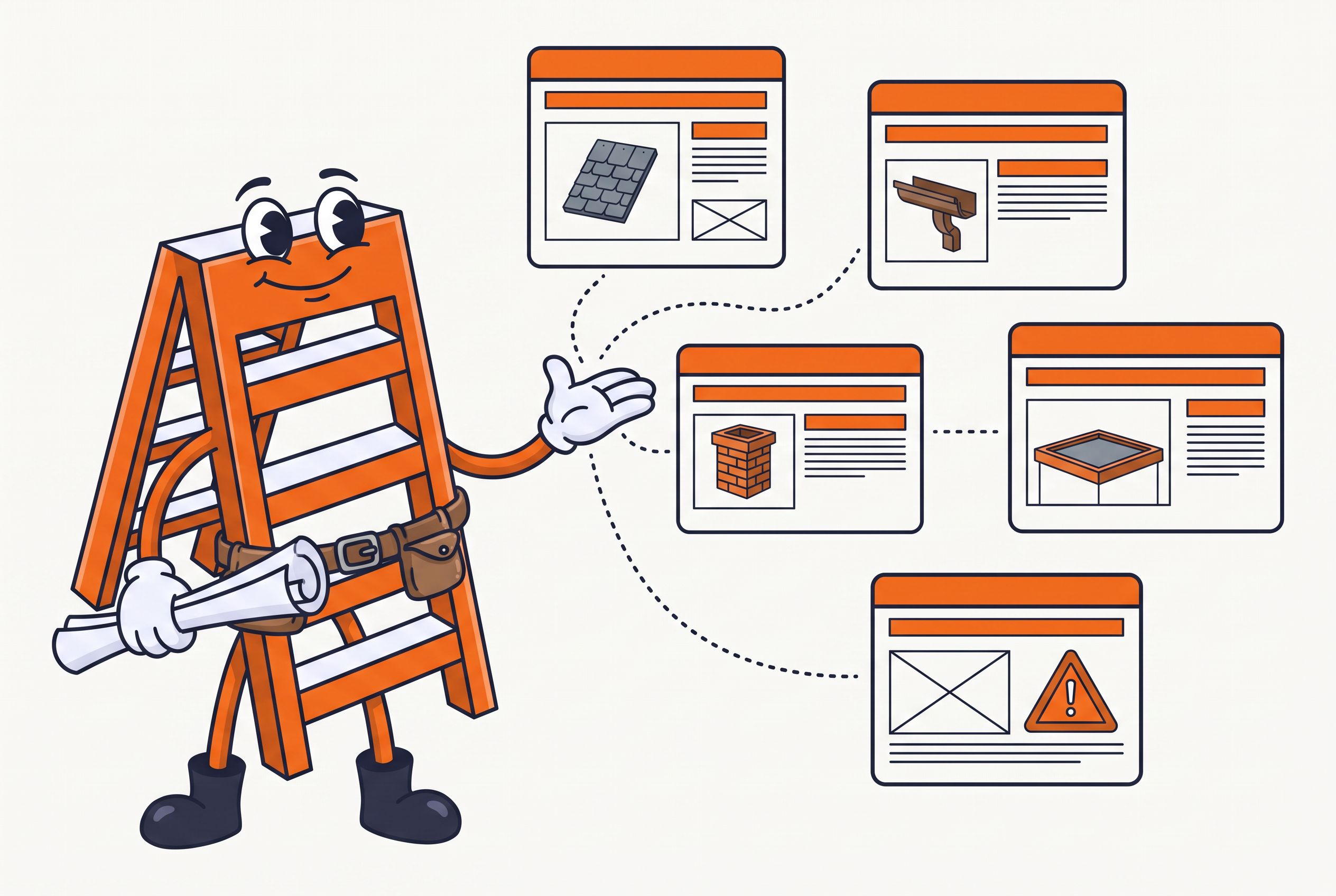
- Roof repairs
- Flat roofing (repair and replacement separately if you do both)
- New roofs and re-roofing
- Guttering and fascias
- Chimney work
- Emergency roofing
- Moss removal
Each page needs the service and your area in the heading, a plain-English explanation of what the job involves and roughly what it costs, photos of your own work, and a visible phone number. 300 words of genuine detail beats 1,000 words of padding.
Moss removal deserves a special mention. It gets 3,600 UK searches a month, competition is thin, and a £200 moss job puts you on the roof of a homeowner who will need repairs eventually. Some of the best-value pages I’ve built are for the unglamorous services.
If you cover several towns, area pages work the same way. I’ve broken down the structure that ranks in this guide to location page SEO.
Reviews decide who gets the call
Put two roofers in the map pack, one with 12 reviews and one with 85. The homeowner with water coming through the ceiling calls the second one. Review count and recency affect both where you rank and whether the ranking converts.
The fix is a habit, not a campaign. Ask every customer on the day the job finishes, by text, with a direct link to your review form. Asking a week later roughly halves the response in my experience; the scaffolding comes down and the goodwill goes with it.
Reply to every review too. Future customers read the replies to judge what you’d be like to deal with, and a reply that mentions the job (“Glad the ridge tiles sorted the leak, thanks Dave”) reads as real because it is.
Your website has to hold its end up
Around 60% of roofing searches happen on a phone, often during or straight after bad weather. A site that loads slowly or breaks on mobile loses the click you just earned.
The checklist is short. Loads in under three seconds on a phone. Phone number visible without scrolling, tappable, on every page. Accreditations (NFRC, TrustMark, CompetentRoofer) shown where people land, with your reviews pulled onto the site.
I’ve covered the eight most common failures in roofing website mistakes that cost you jobs, and walked through a real roofer’s homepage line by line in this homepage SEO teardown. Both are worth reading before you spend anything on a rebuild.
Links and citations, without the snake oil
This is the part of SEO with the most nonsense sold around it. You do not need 500 directory submissions from a £99 gig site. Those links sit on pages nobody visits and help nobody.
What does help a local roofing business:
- Consistent business details (name, address, phone) on the directories that count: Google, Checkatrade, Yell, Trustpilot, and your local directories. Inconsistencies make Google trust your data less.
- Trade body memberships with a live link. An NFRC or CompetentRoofer profile linking to your site is worth more than fifty spam directories.
- Local mentions. Sponsoring the junior football team, a supplier’s project gallery, a mention in the local paper after storm work. One genuine local link a quarter compounds.
Slow and real beats fast and fake. Google has been penalising bought links for over a decade, and roofing is a small enough market that the shortcuts show.
How long does roofing SEO take?
Honest answer, based on doing this for trades sites: map pack improvements come first, often within 2–3 months, because most competing profiles are neglected. Service pages ranking organically take 3–6 months in smaller towns and for specific services like chimney work. Competitive city terms take 6–12 months and need the links section above taken seriously.
Anyone promising page one in 30 days is either targeting keywords nobody searches or about to do something Google penalises.
The timing that matters for roofers is seasonal. Work started in late summer is ranking by the time January storms send “emergency roof repair” searches to their winter peak. Start in January and you’ve missed the season you needed it for.
Doing it yourself versus paying someone
You can do more of this yourself than the industry admits. The profile, the review habit, the photos, consistent directory details: all free, all doable in evenings, and together they’ll move you in the map pack.
Where roofers stall is the website side. Writing eight service pages that rank, fixing a slow site, structuring area pages. That is desk work in the hours you’re on a roof, which in practice means it never happens.
That gap is what I built Local Ladder around. A website built for roofers with the service page structure, review capture and local SEO done properly, without an agency retainer or a contract.
Either way, start the same place this week. Open your Google Business Profile, count the empty fields, then search your trade and town in an incognito window and see who Google shows instead of you. That audit costs nothing, and if you want a second pair of eyes on it, send me your site and I’ll tell you what I’d fix first.
Frequently Asked Questions
How much does SEO cost for a roofing company in the UK?
Doing it yourself costs time rather than money: a Google Business Profile, review requests and better service pages are all free to set up. Paying an agency in the UK typically runs £300–£1,500 a month depending on how competitive your area is. Before signing anything, ask exactly which pages they will build and which keywords they are targeting. Vague deliverables are the biggest red flag in this market.
How long does SEO take to work for roofers?
Map pack improvements usually show within 2–3 months if your Google Business Profile was neglected, because most roofers' profiles are half empty and easy to overtake. Organic rankings for service pages take longer: 3–6 months for smaller towns and specific services like chimney repairs, and 6–12 months for competitive terms in cities. SEO compounds, so every month of work keeps paying after you stop.
Can I do SEO for my roofing business myself?
Partly, yes. Claiming and filling out your Google Business Profile, asking every customer for a review, uploading job photos and keeping your details consistent across directories are all jobs you can do in evenings without any technical knowledge. Where most roofers stall is writing service pages that rank and fixing slow or dated websites. Those need either your winter downtime or someone who does it daily.
Is SEO still worth it for roofers in 2026?
Yes. 'Roofers near me' still gets 33,100 UK searches a month, and roofing searches convert fast because the problem is usually urgent. AI answers in Google now sit above some results, but they pull from the same local data: your Google Business Profile, your reviews and your service pages. The businesses that rank well in normal search are the same ones AI recommends.
What are the best keywords for a roofing website?
Target the searches homeowners make when they need a roofer, in your area. The big UK volumes are 'roofers near me' (33,100 a month), 'roof repairs near me' (9,900), 'flat roof repair' (4,400), 'roof moss removal' (3,600) and 'roof leak repair' (2,400). Pair each service keyword with your town on a dedicated page, and let your Google Business Profile capture the 'near me' searches.
Do I need a new website to rank on Google?
Not always. If your site loads quickly on a phone, has a page for each service and shows your reviews and accreditations, it can rank with better content and a tidied-up Google Business Profile. If it was built more than four or five years ago, is not mobile-friendly, or is a one-page brochure, fixing it usually costs more effort than rebuilding it properly.
See Where You Rank Before You Spend Anything
A free grid of where you rank across your area, who's above you, and the three changes I'd make first. Sent the same working day.
Show Me Where I Rank